Why Iconic Retro Games Still Shape the Way We Play
Some old games survive because they are charming museum pieces. The most iconic retro games survive because they still explain the medium. They taught players how to read screens, chase scores, explore worlds, memorize patterns, share secrets, compete side by side, and imagine bigger adventures from very small pieces of hardware. When people talk about gaming history, these are the titles that keep coming back because their ideas became part of the language every generation inherited.
- Space Invaders turned high scores into a room-wide ritual.
- Pac-Man made game characters recognizable far beyond arcades.
- Donkey Kong connected obstacles to a tiny action story.
- Super Mario Bros. taught movement through playful stage design.
- Zelda made secrets feel like personal discoveries.
- Tetris proved pure rules could become endlessly replayable.
- Street Fighter II built the fighting game blueprint.
- Doom made fast first-person action feel unavoidable.
- Pokemon linked handheld progress to real-world trading.
- Final Fantasy VII raised console RPG expectations worldwide.
- Pac-Man works because the goal is visible immediately.
- Mario's opening screen teaches without stopping play.
- Tetris explains itself through the first falling piece.
- Doom communicates danger through speed, sound, and space.
- Street Fighter II makes every character read differently.
- Zelda invites questions before it gives complete answers.
- Pokemon turns the starter choice into instant identity.
- Space Invaders creates pressure through one descending formation.
- Donkey Kong makes climbing feel dramatic and risky.
- Final Fantasy VII signals scale through mood and music.
- Arcade shooters learned escalation from Space Invaders.
- Mascot games learned approachability from Pac-Man.
- Platformers inherited staging lessons from Donkey Kong.
- Side-scrollers still study Super Mario Bros. pacing.
- Adventure games borrowed Zelda's item-and-secret rhythm.
- Puzzle games keep chasing Tetris-level clarity.
- Fighting games still orbit Street Fighter II structure.
- Shooters inherited Doom's speed and level readability.
- Creature collectors echo Pokemon's trading loop.
- Cinematic RPGs still answer Final Fantasy VII's ambition.
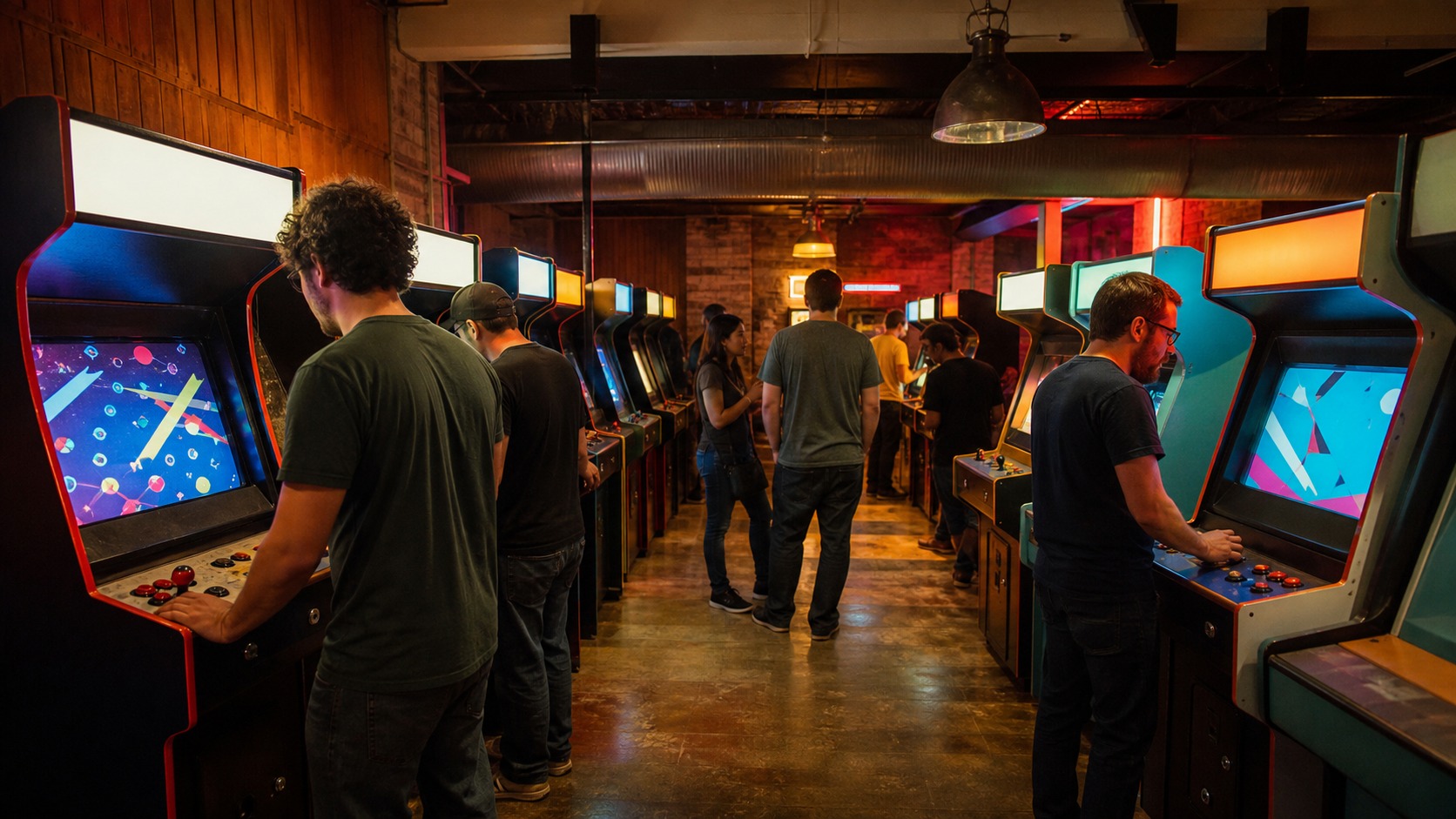
- Arcade crowds made high scores feel like local status.
- Mascot art helped games enter lunchboxes and television.
- Playground rumors turned hidden secrets into shared mythology.
- Link cables made portable progress feel communal.
- Fighting cabinets created rivalries before online ladders existed.
- Shareware helped Doom spread through player networks.
- RPG soundtracks made game music feel emotionally central.
- Puzzle mastery crossed age groups and hardware generations.
- Platforming secrets encouraged players to trade discoveries.
- Retro re-releases keep these histories playable instead of frozen.
- Start with Pac-Man if you want immediate arcade clarity.
- Play Super Mario Bros. to study tutorial-free teaching.
- Try Zelda when you want discovery over linear stages.
- Use Tetris as the benchmark for clean puzzle design.
- Pick Street Fighter II for competitive fundamentals.
- Visit Doom to understand speed in first-person spaces.
- Return to Pokemon for handheld social design roots.
- Sample Final Fantasy VII for RPG scale and mood.
- Watch Space Invaders to see pressure built from simplicity.
- Study Donkey Kong for early character-driven action staging.
Which iconic retro game is easiest to recommend first?
Tetris is usually the easiest because its rules are immediate and its challenge still feels modern.
Which retro game most influenced platformers?
Super Mario Bros. remains the clearest reference point for movement, stage pacing, and readable hazards.
Which arcade classic became the biggest pop icon?
Pac-Man stands out because its character design and sound became recognizable outside normal gaming circles.
Which game changed competitive fighting the most?
Street Fighter II established the character matchups, special moves, and local rivalry structure still central to the genre.
Which retro game best represents pure puzzle design?
Tetris is the strongest example because it turns a few simple rules into endless pressure and improvement.
Which classic helped popularize first-person shooters?
Doom made fast first-person action, modding, and shared levels part of mainstream computer gaming culture.
Which retro game made handheld play more social?
Pokemon Red and Blue used trading, battling, and collecting to connect portable progress with real-world friends.
Which game made exploration feel most influential?
The Legend of Zelda helped define how secrets, tools, saving, and overworld curiosity could support adventure design.
Which older game helped create mascot-driven action?
Donkey Kong gave early platforming a memorable hero, rival, setting, and objective players could instantly understand.
Which RPG expanded console storytelling expectations?
Final Fantasy VII pushed cinematic presentation, emotional music, and long-form party adventures into a larger spotlight.
Space Invaders Made the Arcade Feel Urgent
Before Space Invaders, plenty of arcade machines asked players to react, aim, or keep a simple target in motion. Space Invaders made the room feel like it was under pressure. The marching formation, the falling shots, the protective barriers, and the accelerating rhythm created a sense of escalation that players could understand instantly. Every cleared wave felt like survival, and every mistake felt public because the cabinet was usually surrounded by people waiting for their turn.
Its influence was bigger than one shooter template. Space Invaders helped establish the high score chase as a social ritual, not just a number on a screen. It also showed developers that tension could come from pacing as much as graphics. Modern action games still borrow that lesson whenever enemy pressure rises, music tightens, and a simple objective suddenly feels dramatic.
The genius is how little it needs to create that drama. A few rows of enemies, a cannon, and limited cover become a complete emotional loop because the game keeps tightening the distance between plan and panic. That is why it still feels important when replayed today.
Pac-Man Turned Game Characters Into Pop Culture
Pac-Man is one of the clearest examples of a retro game becoming bigger than its mechanics. The maze, pellets, power pellets, ghosts, and chase reversals are elegant on their own, but the real breakthrough was personality. The main character was readable at a glance, the ghosts behaved with recognizable quirks, and the whole game felt friendly enough to invite players who did not think of themselves as arcade regulars.
That accessibility changed what video games could be in public. Pac-Man proved that a game could become a cultural symbol without explaining itself through long story scenes. It also helped establish mascot design, enemy identity, and sound cues as major parts of the experience. Many modern games still chase the same balance: simple verbs, strong silhouette, immediate charm, and enough depth to keep experts returning.
It also broadened the arcade audience by making play feel mischievous instead of militaristic. The chase was tense, but the tone was bright, strange, and inviting. That tonal shift matters because it made games feel less like machines for specialists and more like shared entertainment.
Donkey Kong Gave Platforming a Star
Donkey Kong mattered because it connected action to a tiny playable drama. Instead of simply clearing abstract obstacles, players climbed construction beams, dodged rolling hazards, and chased a rescue goal at the top of the screen. The game introduced a recognizable hero, a memorable rival, and a staged sense of danger that made the arcade cabinet feel like a miniature cartoon serial.
Its jumping was not as smooth as later platformers, but its structure was historical fuel. Donkey Kong helped define the idea that a character could become the center of a game universe. It also showed that platforming could be about timing, route reading, and personality at once. Many character-driven action games trace part of their family tree back to those ladders, barrels, and tense climbs.
Super Mario Bros. Taught Players a New Grammar
Super Mario Bros. did not merely popularize side-scrolling platformers; it taught millions of players how to think through interactive space. The first screen communicates movement, jumping, enemies, blocks, power-ups, pits, and reward without needing a lecture. That famous opening stretch remains a master class in design because it lets curiosity do the teaching. The game trusts the player to learn by touching the world.
Its larger impact came from consistency. Momentum, secrets, level themes, enemy placement, and power-up rhythm all worked together in a way home console players could replay for months. Super Mario Bros. made level design feel authored, almost musical. Its fingerprints are still visible in tutorials, hidden paths, collectible routes, readable enemy behavior, and the satisfying arc of a stage that starts simple and ends with confidence.
It also helped turn the home console into a place for repeat mastery. Players were not just trying to see the next screen; they were learning how a whole rule set behaved. That made improvement feel tangible, and it gave families a reason to keep returning to the same cartridge.
The Legend of Zelda Made Exploration Feel Personal
The Legend of Zelda gave players a different kind of promise: the world was not just a course to finish, but a place to question. Caves, secrets, tools, dungeons, and overworld routes encouraged players to test ideas and remember discoveries. The ability to save progress made that world feel persistent, which was crucial for turning exploration into a long-term adventure instead of a single-session challenge.
What made it iconic was the feeling that knowledge belonged to the player. Finding a hidden entrance or realizing where a new item could be used created ownership. That design logic echoes through open-world games, action RPGs, adventure games, and metroidvania structures. Whenever a game rewards curiosity with a shortcut, a secret room, or a fresh route, it is speaking a language Zelda helped normalize.
The game also made mystery feel friendly. It was cryptic, sometimes stubborn, but it invited notebooks, conversations, maps, and memory. That social problem-solving became part of its legend and helped transform a cartridge into a shared adventure players carried outside the living room.
Tetris Proved Perfect Design Needs Almost Nothing
Tetris may be the purest argument that a game does not need characters, lore, or spectacle to become timeless. Falling blocks, rotation, lines, speed, and limited space are enough. The rules are understandable within seconds, but mastery can feel endless because every choice changes the shape of the next problem. It is easy to play badly, satisfying to improve, and strangely meditative even when it becomes stressful.
That combination made Tetris one of the most portable ideas in gaming history. It works on handhelds, consoles, computers, phones, and nearly any control setup because its core is so clean. It also influenced how designers think about elegance. The game is iconic not because it is old, but because it remains difficult to improve. Many puzzle games still measure themselves against its clarity.
Street Fighter II Defined Competitive Fighting
Street Fighter II turned one-on-one fighting into a global arcade language. Distinct characters, special moves, spacing, throws, combos, counters, and matchups created a competitive structure that players could study for years. It was approachable enough for casual button presses, but deep enough that local scenes could develop rivalries, etiquette, and reputations around a single cabinet.
The game also made character choice meaningful. Picking a fighter was not just picking a sprite; it meant choosing range, speed, rhythm, and attitude. That idea became foundational for fighting games, hero-based games, and competitive design in general. Street Fighter II showed that balance does not mean every player does the same thing. It means different styles can collide in ways that remain understandable and exciting.
Its legacy is also visible in how players talk about games. Matchups, spacing, reads, execution, and mind games became part of a wider competitive vocabulary. The cabinet did not only host matches; it taught a community how to analyze skill in public.
Doom Made Action Games Feel Fast, Loud, and Shareable
Doom was not the first first-person shooter, but it was the game that made the format feel explosive. Speed, level flow, weapon feedback, enemy pressure, lighting, and sound created a physical sense of momentum. It made players feel like they were inside the action, not looking at a tiny symbolic version of it. That shift changed expectations for what computer games could deliver.
Just as important, Doom helped make modding and sharing central to gaming culture. Players traded levels, experimented with tools, and learned that a game could become a platform for community creativity. Its legacy reaches beyond shooters into user-made content, speedrunning, network play, and the expectation that games can have lives after release. Doom feels historic because it altered both design and distribution habits.
Even now, its levels are worth studying because they turn abstract corridors into readable combat arenas. Doors, lifts, keys, monster closets, and sightlines teach players to move aggressively while still paying attention. That tension between confidence and surprise is a huge part of its staying power.
Pokemon Red and Blue Made Handheld Worlds Social
Pokemon Red and Blue turned a handheld RPG into a playground for collecting, trading, battling, and playground rumor. The games were simple enough for young players to navigate, but broad enough that every team felt personal. Choosing starters, catching rare creatures, linking systems, and hearing rumors from friends made the experience extend beyond the screen.
That social layer is the reason these games remain so important. They showed that portable games could create communities, not just fill spare minutes. Their design connected single-player progression to real-world exchange, and that idea still powers trading systems, collection loops, limited creatures, and multiplayer rituals today. Pokemon made the handheld feel like a doorway to a shared culture.
They also made completion feel wonderfully communal. One player's version, team, rumor, or trade could change another player's path. That sense of partial ownership helped the world feel larger than any single cartridge.
Final Fantasy VII Pushed Console Storytelling Into the Spotlight
Final Fantasy VII arrived when many players were ready to see console games as cinematic, emotional, and ambitious. Its characters, music, pre-rendered backgrounds, summons, and dramatic story beats gave role-playing games a new mainstream visibility. It made a large adventure feel like an event, especially for players who had not previously treated RPGs as essential console experiences.
The game also broadened expectations for production value. It helped prove that long-form storytelling, party building, side content, and spectacle could sell on a massive scale outside the genre's older audience. Whether someone loves or debates its place in history, its impact is hard to ignore. Modern narrative RPGs still live in a world shaped by the door Final Fantasy VII kicked open.
Why These Games Still Matter
The most iconic retro games did not define history by being flawless. They defined it by making new habits feel natural. Space Invaders made pressure visible. Pac-Man made character instantly marketable. Donkey Kong gave platforming a dramatic frame. Mario taught movement. Zelda rewarded curiosity. Tetris proved elegance. Street Fighter II built competition. Doom accelerated action and sharing. Pokemon made handheld play social. Final Fantasy VII widened the emotional scale.
That is why these classics are more than nostalgia. They are reference points for how games communicate, teach, reward, and connect people. New technology keeps changing the surface, but many of the medium's strongest instincts came from these earlier experiments. Playing them now can feel like opening a design notebook that the entire industry kept borrowing from.