Why Classic Arcade Games Still Feel Electric
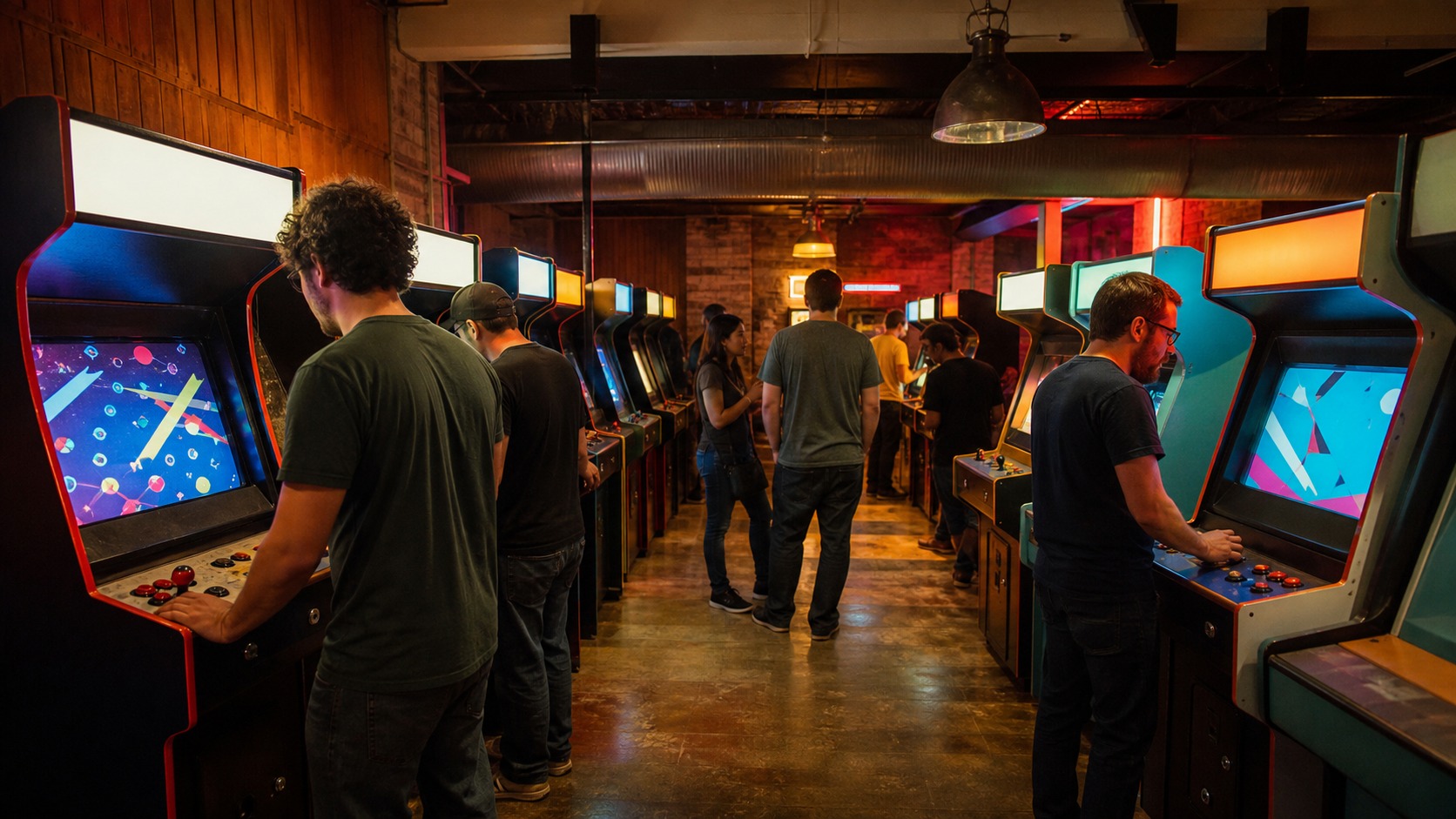
The best classic arcade games were built for a very specific kind of pressure: one cabinet, one screen, one set of controls, and one player trying to make a quarter last longer than expected. That pressure shaped some of gaming's cleanest ideas. Arcade legends had to be readable from several feet away, exciting within seconds, and deep enough that people would line up to try again. The result was a library of games that still feel sharp because they were designed around instant understanding, visible skill, and unforgettable public moments.
- Pac-Man remains the essential maze chase cabinet.
- Space Invaders defined pressure through a descending formation.
- Donkey Kong turned platforming into a tiny action story.
- Galaga made fixed-screen shooting stylish and risky.
- Ms. Pac-Man gave maze chasing more improvisational energy.
- Street Fighter II made head-to-head rivalry unavoidable.
- Mortal Kombat turned secrets and spectacle into arcade currency.
- NBA Jam made sports feel loud, fast, and social.
- Out Run sold driving as motion, music, and mood.
- Asteroids made momentum itself the main challenge.
- A great arcade game explains itself almost immediately.
- Visible high scores gave every attempt public stakes.
- Short sessions made failure easier to accept.
- Distinct cabinets helped each game feel like an event.
- Loud audio pulled curious players across the room.
- Readable controls kept first attempts from feeling hopeless.
- Escalating difficulty made improvement obvious and addictive.
- Crowds turned difficult moments into shared memories.
- Secrets encouraged players to trade rumors between credits.
- Strong silhouettes made games recognizable from a distance.
- Street Fighter II made local rivalries feel personal.
- NBA Jam turned friends into instant opponents and partners.
- Teenage Mutant Ninja Turtles made cooperation easy to join.
- Mortal Kombat made spectators wait for the finish.
- Two-player turns kept score chases social.
- Cabinet crowds created pressure before livestreams existed.
- Shared controls made teamwork loud and physical.
- Winner-stays traditions gave skilled players reputations.
- Arcade sports games lowered the learning barrier.
- Beat em ups made group progress feel effortless.
- Pac-Man rewards memory, routing, and calm reactions.
- Galaga rewards accuracy, wave knowledge, and risk timing.
- Asteroids rewards movement discipline over constant firing.
- Street Fighter II rewards spacing and matchup awareness.
- Donkey Kong rewards patience more than reckless speed.
- Space Invaders rewards target priority under rising pressure.
- Out Run rewards rhythm, traffic reading, and route comfort.
- Ms. Pac-Man rewards adaptation when patterns break.
- NBA Jam rewards timing without losing chaotic energy.
- Mortal Kombat rewards secrets, reads, and composure.
- Start with Pac-Man for pure arcade readability.
- Choose Galaga when you want smooth shooter pacing.
- Pick Street Fighter II for competitive fundamentals.
- Try NBA Jam for instant couch rivalry.
- Play Out Run when atmosphere matters as much as score.
- Return to Asteroids for movement-based survival.
- Use Donkey Kong to study early platform challenge.
- Load Ms. Pac-Man for a faster maze chase.
- Sample Mortal Kombat for arcade spectacle and secrets.
- Gather friends for Teenage Mutant Ninja Turtles.
What makes a classic arcade game great?
The best ones teach quickly, create pressure fast, and give players a clear reason to spend one more credit.
Which arcade game is best for beginners?
Pac-Man is usually the easiest first recommendation because the goal, danger, and reversal mechanic are immediately clear.
Which classic arcade shooter should I try first?
Galaga is a strong starting point because it feels smooth, readable, and exciting without being overwhelming.
Why is Street Fighter II so important?
It created a durable competitive format built around character matchups, spacing, specials, and local rivalries.
Is Ms. Pac-Man better than Pac-Man?
Many players prefer it because the varied mazes and livelier behavior make the chase feel less predictable.
Which arcade game is best with friends?
NBA Jam and Teenage Mutant Ninja Turtles are both excellent because they create instant group energy.
Why does Out Run still stand out?
It made driving feel stylish and atmospheric instead of focusing only on strict racing competition.
Which cabinet is best for pure control mastery?
Asteroids is a great choice because thrust, drift, rotation, and restraint define the entire challenge.
Did Mortal Kombat matter beyond controversy?
Yes, its secrets, presentation, characters, and finishers made arcade competition feel theatrical and memorable.
Do classic arcade games still hold up?
The strongest ones do because their rules are clean, their feedback is immediate, and their skill ceilings remain satisfying.
Pac-Man
Pac-Man remains one of the most perfect arcade designs because the goal is obvious before anyone touches the controls. Eat the dots, avoid the ghosts, grab a power pellet, and turn fear into pursuit. That simple reversal gives the game its magic. The maze never changes much, but every decision matters because timing, routes, and ghost behavior keep shifting the emotional rhythm.
It also widened the arcade audience. Pac-Man was colorful, funny, and characterful at a time when many cabinets leaned on shooting, sports, or abstract competition. Its sound effects, maze layout, and ghost personalities made the cabinet feel welcoming without making it shallow. A newcomer could understand it immediately, while an expert could spend years mastering patterns and improvising escapes.
That blend of friendliness and pressure is rare. Pac-Man can look gentle from across the room, but one bad corner turns it into a chase that makes spectators lean in. The cabinet's genius is that it lets casual players laugh at mistakes while giving serious players a route-planning puzzle with almost no wasted movement.
Space Invaders
Space Invaders earns its place because it made the arcade feel tense in a new way. The descending rows are simple, but the sense of pressure is brilliant. As the invaders disappear, the march speeds up, the sound tightens, and the screen seems to shrink around the player. It is not just shooting targets; it is managing panic.
That structure helped define the high score era. Players were not finishing a story or unlocking a world. They were testing nerve, accuracy, and endurance in front of anyone nearby. Space Invaders proved that a single repeated challenge could become a cultural event when the pacing was strong enough.
Its influence also lives in how arcade games build difficulty from visible systems. Nothing about the danger is hidden. The player can see the formation, the cover, the shots, and the remaining space. That honesty makes failure feel earned, which is a major reason the design still communicates decades later.
Donkey Kong
Donkey Kong gave the arcade a tiny action drama. The player climbs, jumps, dodges, and chases a rescue goal while hazards roll down from above. Instead of pure abstraction, the game creates a little stage with a hero, a rival, and a visible objective. That made each attempt feel like a scene rather than a disconnected challenge.
It is also one of the great early examples of character-driven arcade design. The jumping is strict, the ladders are dangerous, and the level layouts demand patience. Yet the personality keeps pulling players back. Donkey Kong showed that a cabinet could build a star and a world from very few moving pieces.
The game is harsher than many players expect now, which is part of its identity. Every climb asks for commitment, and every jump has to be respected. That demanding feel helped establish platforming as a skill genre, not just a novelty built around a cute character.
Galaga
Galaga refined the fixed-screen shooter into something stylish and rhythmic. Enemy formations swoop into place, peel away in attack patterns, and dare the player to risk a captured ship for double firepower. That risk-reward moment is the game's signature. It turns a setback into a temptation and gives skilled players a reason to play aggressively.
What makes Galaga endure is its feel. Shots are crisp, enemy movement has personality, and each wave creates a small performance. It is easy to grasp after one credit, but the scoring depth and survival demands keep it from becoming disposable. Among classic shooters, it remains one of the easiest to recommend because it still feels smooth.
It also understands the spectacle of near misses. Ships dive in arcs that feel readable but dangerous, and the player is constantly deciding whether to hold position or slide into risk. That makes Galaga exciting to watch as well as play, which is exactly what an arcade cabinet needed.
Ms. Pac-Man
Ms. Pac-Man deserves separate attention because it did more than remix a hit. The mazes are more varied, the fruit movement is livelier, and the ghost behavior feels less predictable. Those changes make the game more improvisational, which is exactly why many arcade fans prefer it. It keeps the clarity of Pac-Man while making each chase feel less solved.
The cabinet also proved that iteration could be meaningful in the arcade. This was not a sequel built only to repeat a name. It sharpened pace, variety, and personality in ways players could feel immediately. Ms. Pac-Man stands as one of the rare follow-ups that can sit beside the original without living in its shadow.
Its faster feel changes the mood of the maze. Players still chase dots, but there is less comfort in memorized safety. That extra uncertainty gives the game a lively edge and makes strong runs feel more improvised, even when a veteran knows the board well.
Street Fighter II
Street Fighter II changed the social temperature of arcades. One-on-one competition existed before it, but this game gave local rivalries a deep shared language. Characters had distinct ranges, speeds, specials, strengths, and weaknesses. Winning was not only about quick reactions; it was about reading another person.
Its cabinet became a gathering point because every match told a compact story. A player could dominate with spacing, steal a round with a risky special, or lose composure under pressure. Street Fighter II made fighting games a serious arcade pillar and helped define competitive gaming long before online matchmaking became normal.
It also made losing educational in a way that kept people engaged. A defeat could reveal a bad habit, a matchup problem, or a move the player needed to learn. That clarity turned the cabinet into a classroom with louder buttons and higher stakes.
Mortal Kombat
Mortal Kombat became unavoidable because it felt dangerous, theatrical, and different from everything around it. The digitized characters, heavy hits, secretive finishing moves, and sharp sound design gave the cabinet a forbidden aura. People crowded around not only to compete, but to see what might happen after the final blow.
Under the spectacle, the game also understood arcade psychology. Secrets made players talk. Finishers made victories memorable. Character selection gave everyone a favorite. Mortal Kombat showed how mystery and presentation could make a cabinet feel like an event, even when players were still learning the deeper competitive details.
That sense of rumor was essential. Players whispered inputs, tested stories, and watched strangers for clues. The game made knowledge feel valuable, and in an arcade setting, valuable knowledge spread through observation, imitation, and excited conversation.
NBA Jam
NBA Jam is one of the best examples of an arcade sports game understanding its environment. It does not try to simulate basketball in a careful way. It turns basketball into speed, shoves, flaming shots, huge dunks, and constant trash talk. The two-on-two format keeps the screen readable, while the exaggeration makes every possession feel dramatic.
That pick-up-and-play energy is why it lasted. NBA Jam was perfect for friends who wanted instant rivalry without studying a manual. It balanced skill and chaos well enough that a newcomer could have fun while a regular could learn timing, hot streaks, and team habits. Few sports cabinets have ever matched its personality.
The game also understood sound as a social hook. Its announcer lines and impact noises made moments feel bigger than the screen. Even people who were not playing could tell when something wild happened, which helped the cabinet pull attention across a busy room.
Out Run
Out Run made driving feel glamorous. Instead of treating racing as a grim fight for first place, it sold the fantasy of speed, branching roads, bright scenery, and music chosen before the drive. The cabinet's presentation mattered as much as the mechanics. Sitting down felt like stepping into a vacation postcard with an engine.
Its importance comes from atmosphere. The game gave players a destination mood rather than only a finish-line goal. The turns, traffic, checkpoints, and route choices still create pressure, but the larger memory is freedom. Out Run proved that an arcade racer could be iconic because of style, motion, and vibe as much as competition.
That atmosphere made replaying feel less like repeating a test and more like taking another route through a fantasy. The branching paths mattered because they gave players a reason to imagine the road continuing beyond one credit.
Asteroids
Asteroids is pure control mastery. The vector graphics are spare, but the movement model is unforgettable. Thrust, drift, rotation, shooting, and screen wrap all combine into a game where survival depends on understanding momentum. Panic firing can split rocks into worse problems, so skill comes from restraint as much as aggression.
That gives Asteroids a different flavor from many classic shooters. It feels lonely, spacious, and hazardous. The screen is open, but never safe. Its clean physics and escalating danger influenced decades of arcade-style design, especially games where the player's own movement is both the solution and the threat.
The minimalist look helps rather than hurts. With so little visual clutter, the player reads motion, angle, and danger directly. Asteroids turns geometry into suspense, which is why the cabinet still feels distinct beside brighter, busier classics.
Teenage Mutant Ninja Turtles
Teenage Mutant Ninja Turtles captured the joy of the multiplayer beat em up. Four players could crowd around one cabinet, choose a favorite character, and push through bright side-scrolling chaos together. The appeal was immediate: hit enemies, grab food, keep moving, and laugh when the screen became crowded.
Its greatness is tied to cooperation. The game was not only about technical depth, although spacing and crowd control mattered more than newcomers realized. It was about shared noise, shared damage, and shared momentum. Few cabinets made group play feel as natural, especially for players who wanted a social arcade experience instead of a solitary score chase.
It also captured the arcade value of recognizable roles. Each player could point to a character and feel attached before understanding the mechanics. That instant identification made it easier for groups to jump in, spend credits together, and treat the cabinet like a shared Saturday ritual.
Why These Cabinets Still Matter
Classic arcade greatness is not one single formula. Pac-Man and Ms. Pac-Man are about route pressure. Space Invaders and Galaga are about formation and rhythm. Donkey Kong is about staging and timing. Street Fighter II and Mortal Kombat are about public rivalry. NBA Jam, Out Run, Asteroids, and Teenage Mutant Ninja Turtles each show a different version of immediate appeal.
That variety is the reason the arcade era still feels alive. These games were designed to communicate quickly, reward improvement visibly, and create memories with other people nearby. Modern games can be larger, prettier, and more convenient, but the best classic arcade games still have something precious: they get to the point, and the point is fun.