Arthur Feels Present Before the Big Speech
Arthur Morgan can speak roughly to an outlaw, reassure a horse, and trade a dry remark with someone at camp without sounding like three different characters. Roger Clark's Red Dead Redemption 2 performance gives those moments a shared physical and vocal identity. Its impact grows through the ordinary exchanges players hear between the larger scenes, where humor, impatience, affection, and responsibility have room to coexist. Clark's account of physically helping Rob Wiethoff during an early John Marston rescue also makes the embodied work tangible. This appreciation examines how the actor carries Arthur through those changing demands, using the camp, travel, and that documented rescue as concrete examples. The memorable result is a person who remains recognizable while responding to very different circumstances.
- Horse interaction gives affection a practical setting.
- Camp greetings establish familiarity before major confrontations.
- Dry humor can reveal skepticism toward grand claims.
- Brief complaints make routine labor feel inhabited.
- A hesitant reply can complicate apparent confidence.
- Friendly exchanges show roughness coexisting with warmth.
- Urgent speech belongs to a changing physical situation.
- Familiar relationships permit disagreement without formal introductions.
- Repeated routines establish a baseline for later change.
- Ordinary contact makes dramatic pressure easier to recognize.
- Listen during a quiet ride between objectives.
- Compare camp responses to different familiar people.
- Observe how Arthur addresses his current horse.
- Reassurance during horse care gives Arthur warmth inside a practical activity.
- Consider the relationship behind a dry remark.
- Notice when practical urgency changes vocal energy.
- Examine a disagreement without assuming all loyalty disappears.
- Follow a routine exchange before a large cinematic.
- Look for small adjustments across repeated encounters.
- Separate an emotional effect from an invented recording anecdote.
- Belonging can coexist with doubt about another person.
- Horseshoe Overlook lets repeated greetings establish how Arthur behaves among familiar people.
- Affection makes some disagreements harder to dismiss.
- Skepticism may emerge without a complete rupture.
- A group's familiar habits create social expectations.
- Other characters give Arthur distinct pressures to answer.
- Player-directed behavior adds tension to authored characterization.
- Repeated contact keeps relationships from feeling newly introduced.
- Confidence can sound less secure as circumstances change.
- Moral complexity needs specific interactions to become legible.
- Clark's account of the John rescue includes physically lifting Rob Wiethoff during capture.
- The set horse gave the rescue a performed destination for carrying the injured character.
- Performance capture gives recorded scenes embodied circumstances.
- Animation work develops and implements performed material.
- Camera presentation determines which physical details are visible.
- Player-controlled actions have separate interactive requirements.
- Vocal urgency should fit the action around it.
- Recorded foundations do not constitute every finished movement.
- A familiar resting stance helps create recognizable presence.
- Integrated voice and movement make the character feel situated.
- Routine material reveals craft without exposing late events.
- The 2018 Game Awards archive documents Clark's win.
- John Wayne and Toshiro Mifune were among Clark's stated preparation references for Arthur.
- An award does not settle every listener's preference.
- Personal praise improves when attached to observable behavior.
- Humor supplies contrast for more pressured exchanges.
- Earlier familiarity makes a later adjustment meaningful.
- Supporting actors contribute to Arthur's social credibility.
- Story progression should remain distinct from invented biography.
- A long adventure gives small differences cumulative force.
Who performs Arthur in Red Dead Redemption 2?
Roger Clark portrays Arthur Morgan.
Why focus on horse interactions in an acting discussion?
They show character within an everyday practical exchange.
What does Clark's account of rescuing John reveal about his work?
He physically lifted Rob Wiethoff and helped him onto a set horse, giving the scene embodied circumstances during capture.
What major 2018 performance award did he receive?
The Game Awards named him Best Performance winner as Arthur.
Does every Arthur animation belong solely to Clark?
The finished character also depends on animation and interactive production.
Can Arthur's humor contribute to dramatic credibility?
It gives the character registers beyond toughness or distress.
How does camp support the portrayal?
Recurring contact establishes familiarity and changing relationships.
Which preparation references did Clark name for Arthur?
He identified John Wayne and Toshiro Mifune alongside work on dialect and physicality.
Must analysis disclose Arthur's late-story circumstances?
Ordinary scenes already reveal many of the performance's strengths.
What makes an emotional change convincing over time?
Players recognize it against a baseline established by earlier encounters.
The Ordinary Material Gives Arthur a Daily Life
An outlaw protagonist could easily be defined only by confrontations, weapons, and major plot decisions. Arthur becomes more interesting when the game gives him ordinary contact with the people and animals around him. A greeting, a complaint, or a practical exchange can establish how he occupies a shared space. These moments do not need to reveal a new secret each time. Their value is cumulative: the player learns what it feels like to spend time with this particular person before a crisis demands a different response.
Clark's delivery helps routine material belong to that person. A brief line can carry mild amusement, impatience, affection, or resignation without changing the scene into a formal declaration. Those distinctions are useful because ordinary conversation rarely announces its entire emotional purpose. Players recognize a familiar manner and notice when it shifts. The observation describes the performance's effect in the finished game, without claiming access to the exact direction given for every recorded line.
The game's pacing gives those small exchanges room to register. Traveling, returning to camp, and approaching familiar people repeatedly creates opportunities to establish a baseline. A character known only through a montage of intense moments would have less everyday texture. Arthur's presence grows through time spent around him. That makes a casual scene more than filler between missions: it supplies the recognizable habits that larger dramatic changes can later complicate.
A Recognizable Voice Is the Beginning of the Effect
Arthur's voice is easy for many players to recognize, but its importance is in how it changes with the listener. A reply to a horse, a familiar gang member, and an immediate threat needs a different social purpose. Clark keeps the person recognizable while adjusting warmth, force, and pace. The accent supplies an identity; the changing response supplies someone living within a situation.
At camp, Arthur can answer familiar people with a dryness that assumes an existing relationship. A complaint need not sound like the announcement of a permanent feud. The listener hears irritation beside belonging, which helps a group of outlaws feel like people accustomed to sharing space. Humor can communicate how Arthur handles another person's behavior rather than simply supply a joke for the audience.
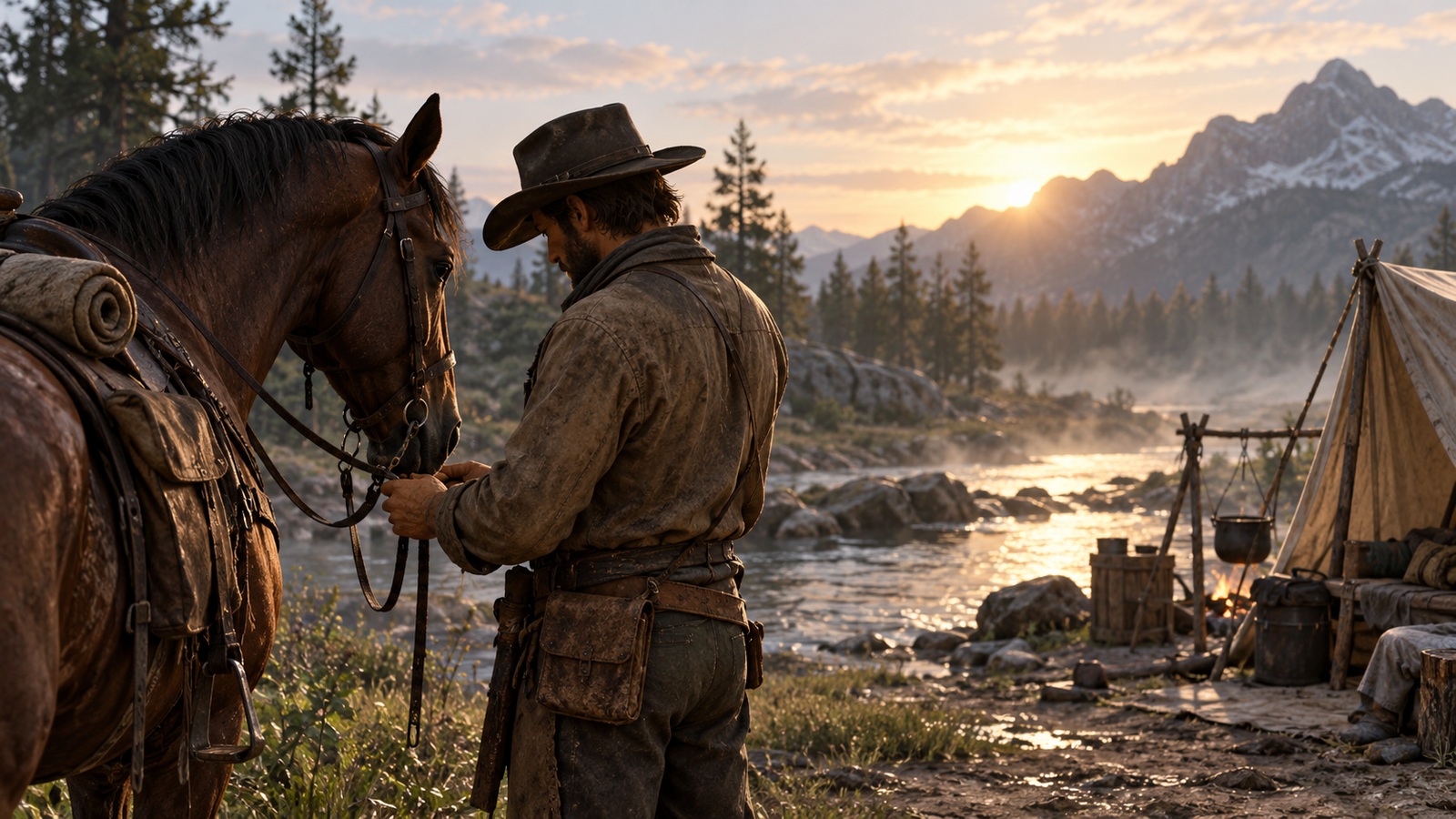
During horse care and travel, the voice can become more reassuring without replacing that familiar identity. The practical activity gives the warmth a reason to appear. It is different from delivering an affectionate speech in a dramatic scene. The player repeatedly hears that quieter register while doing ordinary work, so it becomes part of Arthur's daily manner.
The contrast is more revealing than treating one impressive sound as the entire performance. Clark has said he worked on dialect and physicality and studied John Wayne and Toshiro Mifune while preparing Arthur. Those reference points do not make Arthur an imitation of either performer. The finished role has to hold together across conversations, travel, danger, and the player's changing pace.
Humor Lets the Character Exceed His Tough Image
Arthur's humor can reveal a different relationship with the world from the one suggested by an armed silhouette. A dry response may express irritation, a small kindness, or an unwillingness to take another person's grand claim at face value. The distinction depends on context and delivery. A joke that lands among familiar people can feel different from a similar remark during a tense encounter. That flexibility lets the character remain rough without becoming emotionally uniform.
Humor also creates room for contradiction. Arthur can sound capable and still be awkward, skeptical, or caught off guard. Those moments make him easier to understand as someone who lives among other people, rather than as a figure constructed only to project authority. Clark's performance works with the writing and the responses of other actors to produce that effect. The player is hearing an exchange whose meaning belongs to the relationship, not a detached collection of memorable one-liners.
Physical Presence Matters as Much as Spoken Force
Clark has discussed performance capture directly in an interview published by the official Star Trek website. That account is a useful primary source for understanding his work as more than isolated voice recording. A character's physical behavior and spoken response can originate in a performed situation, then be developed through the game's animation and presentation. The finished result still involves many contributors. The useful point is that a scene has embodied demands: where a person stands, what they are doing, and how much effort the action requires.
Arthur often seems physically settled into his environment. His movement can suggest weight, fatigue, readiness, or the practical habit of someone accustomed to outdoor work. Those impressions affect how a line reads. A remark delivered while standing comfortably beside a familiar person has different force from one delivered during an urgent movement. When voice and physical context support each other, the player does not need to separate them consciously. They experience one person acting within the scene.
This is also why praising the performance should leave room for the animation team. Recorded acting does not transfer into a game without decisions about editing, blending, implementation, and camera presentation. Some actions may be player-controlled or supplied through other production processes. Clark's documented contribution is significant without becoming a claim that he authored every movement Arthur can perform. Accurate credit makes the craft clearer by identifying how a performed foundation meets the systems of an interactive character.
Camp Makes Relationships Feel Repeated Rather Than Introduced
A camp gives the player a recurring social setting. Returning to people in a familiar place allows relationships to be understood through repetition, disagreement, and changing circumstances. Arthur does not need to greet every person as if the audience has never encountered them before. The familiarity helps make the group feel like a community with habits and tensions. A casual exchange can suggest a relationship that continues beyond the immediate scene.
That social setting makes loyalty more complicated than a simple declaration of belonging. Arthur's responses can carry affection, skepticism, frustration, and practical responsibility at different moments. The player sees a person negotiating membership rather than embodying one permanent attitude toward the gang. Other performers help create that complexity by giving him distinct people to answer. The ensemble matters because Arthur's position becomes legible through the differences among the relationships around him.
The physical side becomes concrete in Clark's account of the early rescue of John Marston from wolves. He describes actually lifting Rob Wiethoff onto his shoulder and helping him onto a set horse during capture. Arthur's practical effort was therefore grounded in a task performed with the other actor, not merely imagined as a line spoken into a microphone. Weight, movement, and the relationship with the person being helped supplied circumstances the performance could answer.
Compare that rescue with returning to Horseshoe Overlook and greeting a familiar gang member. One moment asks Arthur to carry someone through danger; another asks him to negotiate an ordinary social encounter. Both make his physical and vocal behavior serve an immediate purpose. This is why a quiet greeting can strengthen the later dramatic work: it establishes someone whose effort and responsibility the player already recognizes. The everyday scene provides a baseline without needing to announce it as character development.
Player Choices Change the Surrounding Moral Pressure
Red Dead Redemption 2 permits player-directed behavior within an authored story, so Arthur can be encountered through runs with different patterns of action. The performance must remain understandable amid that variation. A player may emphasize helpful behavior, provoke trouble, or alternate between impulses, while the main narrative continues to develop a particular character. That tension is part of interactive storytelling. It does not mean every combination is perfectly seamless, but it explains why the actor's job involves more than one fixed sequence of emotional scenes. Consistency needs to be broad enough to survive the player's contribution without making Arthur sound indifferent to every situation.
Change Becomes Credible Through Earlier Familiarity
A long story gives players time to recognize what feels usual for Arthur. Once that familiarity exists, a changed response can become meaningful even without a large visual signal. A different degree of patience, a moment of uncertainty, or an altered relationship to another person's confidence can carry dramatic weight. The player compares the current behavior with remembered encounters. The transformation is effective partly because its earlier baseline was established through so much ordinary material.
A spoiler-light discussion does not need to identify the story's decisive late events to explain this mechanism. It is enough to observe that a performance can develop through changes in emphasis, energy, and social response. Those changes need continuity to remain convincing. If every stage of the character sounded unrelated to the previous one, the audience would experience replacement rather than development. Clark's Arthur gives players a recognizable person whose responses can become more complicated over time.
The strongest emotional material also benefits from not being the only register available. A character who is always at maximum distress has little contrast left for a particular moment. Routine activity, humor, and companionship supply other textures. When pressure rises, the listener has a larger range against which to judge it. The dramatic scene carries the accumulated memory of a person previously encountered under several kinds of circumstance.
Recognition From Awards Is Documented, Affection Is Personal
The Game Awards' official 2018 archive lists Roger Clark as Arthur Morgan as the Best Performance winner. That is a specific, verifiable distinction. PlayStation's reader-voted 2018 awards also recognize his performance, providing another dated account of its reception. These records are useful without turning appreciation into a universal ranking. An award establishes the result of a particular selection process; it does not explain every individual's relationship with the character.
Players may remember different parts of the work. One person might respond most strongly to the humor, another to a relationship, and another to the everyday sense of physical presence. Those reactions can coexist without needing to be reduced to one definitive reason Arthur is special. A thoughtful appreciation connects its judgment to a scene or a recurring behavior the reader can examine. That makes praise more informative than the unsupported assertion that no other performance could ever compare.
Listen to a Routine Exchange Before a Famous Scene
For a practical way to notice the craft, pay attention during an ordinary return to camp or a quiet stretch of travel. Consider whom Arthur is addressing, what he wants from the exchange, and how the physical situation affects the delivery. Then compare another routine interaction with a different relationship or level of urgency. The exercise does not require replaying a major spoiler or isolating a dramatic speech. It reveals how a sustained character is built through small differences that remain connected to a familiar identity.
The Achievement Is a Person Who Survives Different Moments
Roger Clark's Arthur Morgan is memorable because the character can occupy different registers without losing coherence. Roughness does not prevent warmth, humor does not eliminate moral pressure, and competence does not remove uncertainty. The performance gives those tensions recognizable form through voice and embodied acting, while the wider production makes them available across an interactive adventure. The result is someone the player can encounter repeatedly without feeling that every exchange exists only to explain the next plot event.
Arthur's major scenes gain force because the player already knows his routine responses. The reassurance during horse care, the dry exchanges with familiar people, and the physical rescue each establish a different demand he can meet. Clark's work carries that identity across the adventure while animation, writing, and implementation make it available during play. The achievement is a coherent person with room for contradiction, whose changing response means something because the player remembers how he usually occupies the world.