Why VR Simulation Feels Different
The most realistic VR simulation games ever created work because VR gives players a sense of position, scale, and embodied attention that normal screens struggle to match. A cockpit surrounds you, a track bends around you, a landing approach has depth, and a control panel feels like something you occupy rather than watch. Realism in VR is not only about graphics or physics. It is about whether the headset makes the role feel believable.
- Microsoft Flight Simulator VR defines aviation presence.
- DCS World offers deep combat flight realism.
- Assetto Corsa Competizione rewards racing focus.
- iRacing adds competitive seriousness to VR driving.
- Elite Dangerous VR sells cockpit-scale spaceflight.
- No Man's Sky VR simulates exploration and arrival.
- Euro Truck Simulator 2 VR makes routine driving immersive.
- VTOL VR builds aircraft interaction for tracked hands.
- Derail Valley VR gives train work physical weight.
- Blade & Sorcery highlights body-based physics realism.
- Flight realism comes from procedure and cockpit scale.
- Racing realism comes from depth and track awareness.
- Space realism comes from navigation and vastness.
- Trucking realism comes from routine and road discipline.
- Train realism comes from weight and planning.
- Physics realism comes from motion and contact.
- Exploration realism comes from arrival and resource loops.
- Combat realism comes from workload and awareness.
- Cockpit realism benefits from seated play.
- Interaction realism depends on responsive hands.
- Use a wheel for serious racing sims.
- Use pedals for better driving consistency.
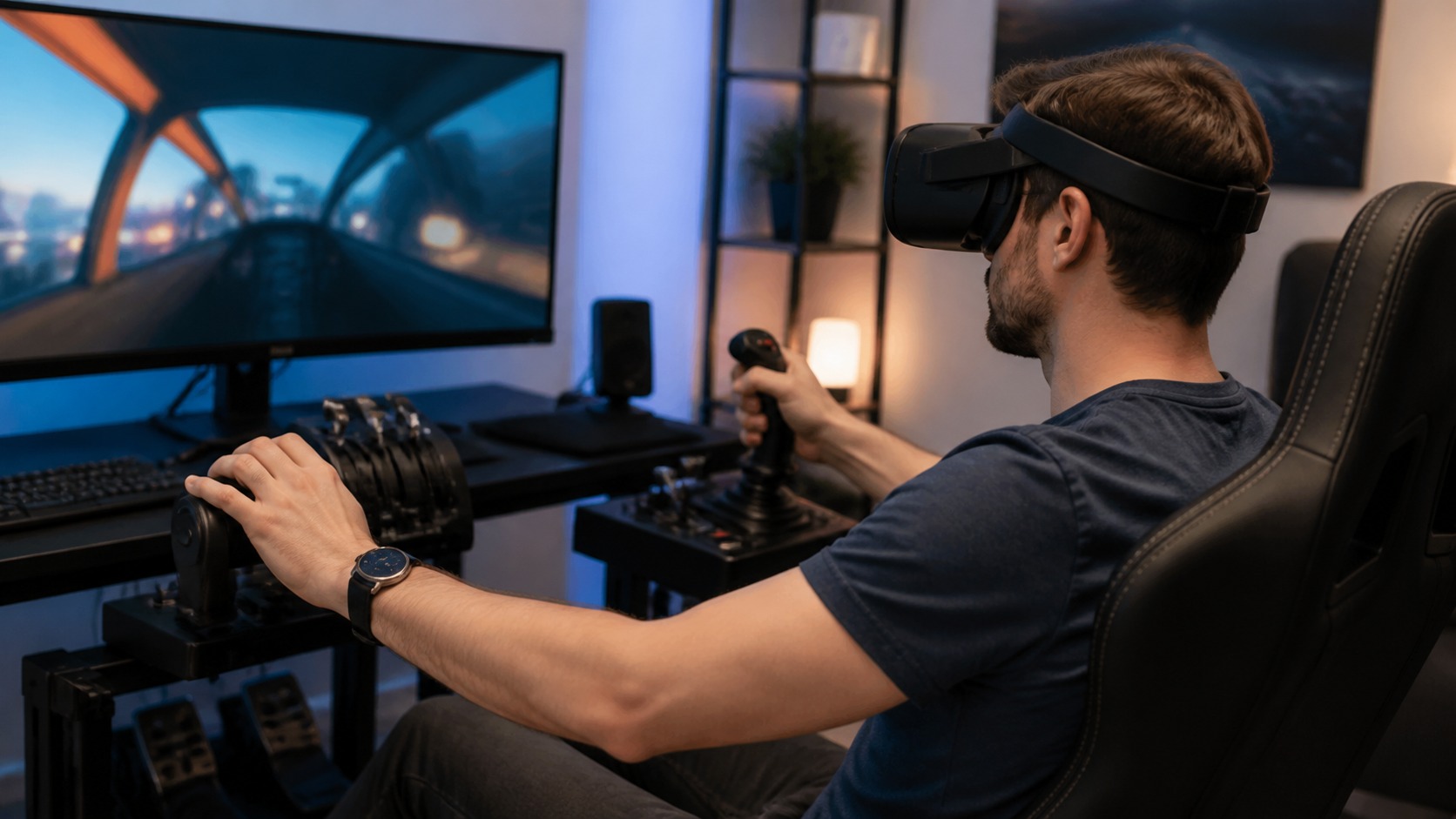
- Use a joystick or HOTAS for flight depth.
- Use seated VR for cockpit-heavy games.
- Prioritize stable frame rates in simulation.
- Adjust comfort before long sessions.
- Map important controls before starting.
- Keep physical space clear around rigs.
- Use headphones for spatial awareness.
- Tune graphics for readability over flash.
- Start with Microsoft Flight Simulator for awe.
- Try Euro Truck Simulator for relaxed realism.
- Use VTOL VR for VR-native cockpit interaction.
- Try No Man's Sky for accessible exploration.
- Choose Elite Dangerous for patient space travel.
- Pick Assetto Corsa for racing immersion.
- Approach DCS after learning basics.
- Try Derail Valley for slow machinery focus.
- Use Blade & Sorcery for physics experimentation.
- Try iRacing when competition matters most.
- VR makes cockpit scale easier to believe.
- Depth helps judge corners and landings.
- Head tracking supports natural scanning.
- Physical controls deepen role-play.
- Seated setups reduce locomotion discomfort.
- Long sessions reward comfort tuning.
- Realistic routines can become meditative.
- Complex systems feel more grounded in VR.
- Spatial audio improves situational awareness.
- Stable performance protects simulation presence.
What is the most realistic VR simulation game?
Microsoft Flight Simulator VR and DCS World are two of the strongest realism showcases, depending on whether you want civil or combat flight.
What is the best VR racing simulator?
iRacing and Assetto Corsa Competizione are both excellent for serious racing in VR.
Which VR sim is best for beginners?
Euro Truck Simulator 2 VR or Microsoft Flight Simulator VR can be approachable if settings are tuned carefully.
Do I need extra hardware for VR sims?
You can play some with controllers, but wheels, pedals, joysticks, or HOTAS setups greatly improve realism.
Why are cockpit games good in VR?
The player's real seated posture matches the virtual role, which helps comfort and presence.
Is No Man's Sky VR a realistic sim?
It is not strict realism, but it simulates exploration, travel, and planetary scale very effectively.
What makes VTOL VR special?
It was designed around VR hand interaction, making cockpit controls feel natural without a full hardware rig.
Can slow simulation games be immersive?
Yes, trucking, trains, and flight routines can become deeply absorbing because VR supports process and scale.
What matters most for VR sim comfort?
Stable performance, readable instruments, good seating, and control familiarity are all important.
Are physics games simulations too?
They can be, especially when body movement, weight, distance, and contact are central to the experience.
Microsoft Flight Simulator VR
Microsoft Flight Simulator VR is one of the most obvious realism showcases because flight and VR fit naturally together. The player is seated in a cockpit, surrounded by windows, instruments, weather, terrain, and a horizon that can be scanned by moving the head.
The realism comes from procedure as much as visuals. Taxiing, taking off, climbing, checking instruments, lining up an approach, and landing all feel more connected when the cockpit surrounds the player. Even a calm flight can become absorbing because the viewpoint feels correct.
It is demanding, and it rewards patience, but that is part of the appeal. Players who want a serious simulation fantasy can spend countless hours learning aircraft, routes, and approaches. VR turns that learning into presence.
For anyone interested in realistic VR simulation, this is one of the clearest benchmarks. It shows how a headset can make a familiar sim feel less like software and more like a role.
DCS World
DCS World is a heavyweight combat flight simulation, and VR makes its cockpit intensity even stronger. Looking through the canopy, tracking targets, reading instruments, and managing complex aircraft systems becomes more natural when the player can move their head like a pilot.
The learning curve is steep, but the realism audience often wants that depth. Procedures, weapon systems, aircraft behavior, and situational awareness all demand focus. VR does not simplify the sim; it makes the complexity feel more physically grounded.
Its strongest moments come from workload. The player is not just flying; they are scanning, thinking, reacting, and managing space. That kind of mental load can be exhausting, but it is also what makes the simulation feel serious.
DCS World is not the friendliest first VR sim, but for players who want aviation realism and combat depth, it is one of the most impressive options ever created.
Why Combat Flight Feels So Demanding
Combat flight realism is not only about how an aircraft handles. It is about workload under pressure. The player has to understand instruments, altitude, targets, weapons, threats, and escape routes while still flying the aircraft. VR makes that workload feel closer to the body because looking around becomes part of survival.
That is why DCS can feel intimidating and thrilling at the same time. It asks players to learn procedures instead of pretending mastery is instant. For the right audience, that seriousness is exactly the attraction.
Assetto Corsa Competizione
Assetto Corsa Competizione is a standout for realistic VR racing because cockpit perspective changes how players understand tracks. Corners, braking points, elevation changes, mirrors, and nearby cars all feel more immediate when depth and head movement are part of the experience.
The realism also comes from commitment. Racing in VR asks players to look through corners, judge spacing, and feel the car's relationship to the track through consistent visual feedback. A wheel and pedals make the illusion even stronger.
It can take tuning to get the ideal VR setup, but the payoff is substantial. Once everything is dialed in, the sensation of sitting inside a GT car and fighting for position becomes deeply convincing.
For sim racers, VR can transform practice. It makes familiar tracks feel newly physical, especially when the player has a proper seating position and stable performance.
Why Racing Benefits From Depth
Depth perception is a major reason racing sims work in VR. A flat screen can show a corner, but VR helps players feel how the track bends away, how close another car is, and how much space remains on exit. That does not replace skill, but it changes how information arrives.
A good wheel and pedals complete the illusion because the player's hands and feet match the fantasy. When visual depth, physical controls, and cockpit perspective line up, racing becomes one of VR's most convincing simulation categories.
iRacing
iRacing is one of the most serious racing simulations, and VR adds a powerful layer of spatial awareness. The competitive structure, licensed tracks, car behavior, and online racing culture already demand precision. In VR, that precision feels more embodied.
Depth perception helps with apexes, traffic, and side-by-side battles. The player can glance into corners, check mirrors naturally, and sense track width more intuitively. That does not automatically make someone faster, but it can make the driving experience feel more authentic.
The realism here is also social. Racing against other committed drivers makes every mistake matter. VR intensifies that pressure because the cockpit feels like a real place to protect.
iRacing is best for players who want simulation as a hobby, not a casual novelty. For that audience, VR can make the hobby feel even more alive.
Elite Dangerous VR
Elite Dangerous VR turns spaceflight into one of VR's great seated simulation fantasies. The cockpit gives the player a stable frame, while stars, stations, planets, and ship interiors create an enormous sense of scale.
Its realism is not the same as a flight school sim. It is a believable science-fiction cockpit fantasy built around navigation, travel, combat, mining, docking, and long-distance routes. The headset makes the ship feel like a place.
Docking is one of the best examples. Approaching a station, lining up carefully, and judging position through the canopy feels more dramatic in VR than on a flat screen. Small procedures become memorable because the player is physically situated.
Elite Dangerous VR remains one of the most convincing ways to feel like a pilot in a vast universe. The pace is slow for some, but the immersion is excellent for players who enjoy cockpit scale.
No Man's Sky VR
No Man's Sky VR is less strict as a simulator, but it deserves mention because it simulates exploration, travel, and planetary scale in a way that benefits enormously from VR. Flying, landing, scanning, mining, and walking under alien skies all feel more convincing in the headset.
The game is not aiming for technical realism like DCS or iRacing. Its realism is experiential. It asks whether the player believes in the loop of arriving somewhere, collecting resources, repairing gear, and moving deeper into a huge universe.
VR strengthens that loop by making ships, planets, and weather feel larger. Even familiar actions gain texture when the player reaches, looks, and stands inside the scene.
For players who want a softer, more accessible simulation of exploration, No Man's Sky VR remains one of the most compelling options.
Euro Truck Simulator 2 VR
Euro Truck Simulator 2 VR shows that realism does not need explosions or speed to be absorbing. Driving long routes, checking mirrors, managing lanes, parking trailers, and watching roads unfold can become deeply relaxing inside a headset.
The cab perspective is a natural fit. Sitting in a truck, looking out the windows, and judging the size of the vehicle all feel more convincing with head tracking. The game turns routine driving into a steady simulation rhythm.
Its appeal is partly meditative. The player settles into a route, listens, scans traffic, and focuses on smooth control. VR supports that mood because it reduces the feeling of watching from outside.
For people who enjoy slow, grounded simulation, Euro Truck Simulator 2 VR can be surprisingly powerful. It proves realism can be quiet and still feel immersive.
VTOL VR
VTOL VR is one of the most interesting VR-native simulation games because it builds cockpit interaction around motion controllers. Players flip switches, use controls, manage weapons, and fly aircraft with an interface designed specifically for virtual reality.
That VR-native design matters. Instead of simply placing a traditional sim in a headset, VTOL VR asks what cockpit operation can feel like when hands are tracked. It is not as visually extravagant as some sims, but its interaction model is extremely coherent.
The result is a believable middle ground between accessibility and depth. Players can learn systems, fly missions, and manage aircraft without needing a full physical cockpit setup.
VTOL VR deserves a place because it shows another path for simulation realism. Physical interaction can be just as important as raw graphical detail.
Why VR-Native Controls Matter
Traditional sims often assume keyboards, button boxes, wheels, or HOTAS setups. VTOL VR starts from a different question: what if the cockpit itself could be operated with tracked hands? That makes switches, screens, and controls feel more directly connected to the player.
This does not make it the most technically exact sim in every category, but it makes the role feel coherent inside VR. For many players, that coherence is what realism actually feels like in the headset.
Derail Valley VR
Derail Valley VR is a strong train simulation choice because it makes heavy machinery feel physical. Coupling cars, managing locomotives, handling routes, and operating controls become more immersive when the player can move through the cab and interact directly.
The realism comes from process. Trains are not only about speed; they are about weight, planning, braking distance, cargo, and careful control. VR makes those processes feel hands-on and spatial.
It also benefits from a slower pace. Players have time to inspect, plan, and understand what the machine is doing. That slower rhythm can make the world feel more believable than a constant rush of action.
Derail Valley VR is a great example of simulation as work fantasy. It makes a specialized activity feel approachable without removing its sense of weight.
Blade & Sorcery
Blade & Sorcery is not a realistic life simulator, but it is important for physics-based body interaction. Weapons, weight, distance, and motion matter in a way that many action games fake. The result can feel startlingly physical.
Its realism is mechanical rather than practical. The game asks players to swing, block, grab, throw, and move with awareness of space. That makes it one of the clearest examples of VR physics selling a fantasy through hands and body movement.
It is intense and not for everyone, but simulation fans often appreciate how much it depends on embodied interaction. The world may be fantasy, but the physical language is what makes it convincing.
Blade & Sorcery belongs here because VR realism is not limited to vehicles. Sometimes realism means the difference between pressing attack and actually moving through an action.
What Realism Means in VR
Realistic VR simulation is not one category. Flight sims, racing sims, space sims, trucking, trains, and physics sandboxes all create realism differently. Some rely on accurate systems. Others rely on scale, cockpit framing, or physical interaction.
The best examples make the player's body position make sense. Seated sims work because the player is seated in real life. Hand-driven sims work because tracked controllers become tools. Physics games work because distance and motion matter.
That is why VR can make simulation feel so special. It does not only add depth to the image. It gives players a role they can inhabit with their eyes, hands, posture, and attention.
Choosing the Right VR Sim Setup
The best simulation setup depends on the fantasy. Flight players may want a joystick, throttle, or HOTAS. Racing players benefit from a wheel and pedals. Trucking and train players may prefer comfort, readable controls, and long-session stability. Not every sim needs expensive hardware, but good physical inputs can make realism much stronger.
Performance matters too. A beautiful sim can become uncomfortable if the frame rate is unstable or instruments are hard to read. For VR simulation, smoothness and clarity usually matter more than maxed-out visual settings. The most realistic experience is the one you can stay inside comfortably.