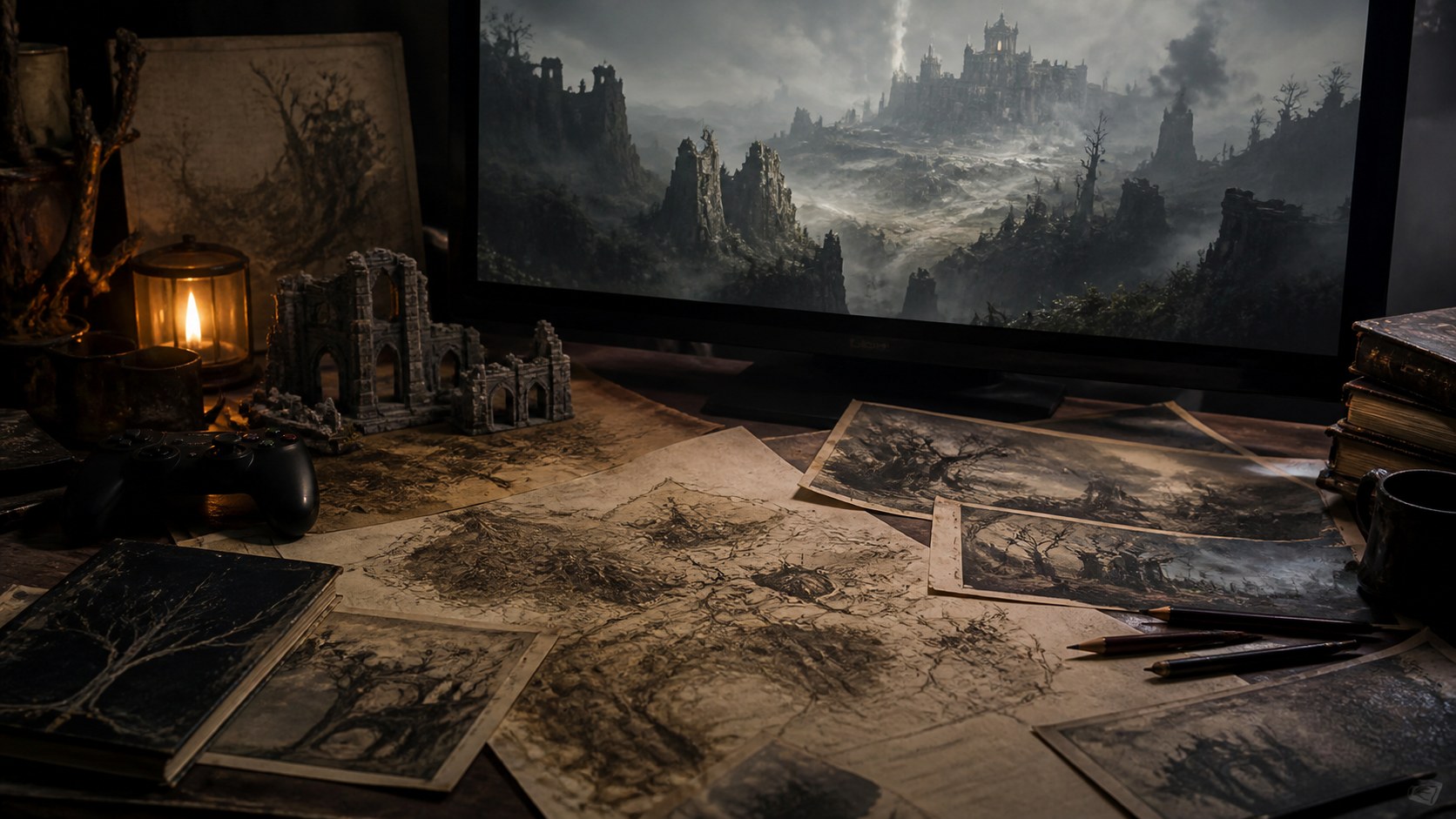
Why Hidetaka Miyazaki Changed Modern Gaming
Hidetaka Miyazaki changed modern gaming by making difficulty, mystery, and environmental storytelling feel newly central. His work with FromSoftware helped turn Demon’s Souls, Dark Souls, Bloodborne, Sekiro, and Elden Ring into reference points for players and designers. The influence is not only about hard bosses. Miyazaki’s games trust players to observe, fail, interpret, explore, and share discoveries. They create worlds that feel ancient, hostile, beautiful, and half-explained. Behind the controller, his design philosophy asks players to earn understanding through attention.
- Demon's Souls introduced a harsh but deliberate design language.
- Dark Souls made interconnected world design famous.
- Bloodborne pushed aggression, horror, and cosmic mystery.
- Sekiro focused on rhythm, deflection, and posture.
- Elden Ring expanded the formula into an open world.
- Bonfires made rest and risk part of one rhythm.
- Online messages created strange indirect community.
- Item descriptions became lore fragments.
- Boss fights taught through repetition and consequence.
- His games helped popularize the Soulslike conversation.
- Difficulty works best when it teaches.
- Mystery invites players to interpret rather than only receive.
- World design rewards memory and observation.
- Shortcuts make spaces feel intelligent.
- Failure becomes part of learning.
- Atmosphere can carry story without exposition.
- Community knowledge extends the game outside the screen.
- Combat asks for patience and timing.
- Exploration gives players agency over challenge.
- Fragments can create stronger curiosity than full explanation.
- The open world gave players more routes around difficulty.
- Landmarks created constant curiosity.
- Build variety supported different play styles.
- Legacy dungeons preserved dense level design.
- Cooperative and message systems made discovery social.
- Bosses created shared cultural moments.
- The world felt ancient and half-understood.
- Freedom made challenge feel less linear.
- Exploration rewarded patience repeatedly.
- It brought Soulslike design to a wider audience.
- Many games borrow bonfire-like checkpoints.
- Corpse-run mechanics became widely recognizable.
- Stamina combat influenced action RPGs.
- Environmental storytelling gained new attention.
- Cryptic lore communities became part of fandom.
- Boss design increasingly emphasized readable patterns.
- Difficulty debates became mainstream.
- Interconnected maps became a design ideal.
- Players learned to value opacity when it felt fair.
- Soulslike became a common genre label.
- Miyazaki's public legacy depends on FromSoftware teams.
- A director shapes priorities but does not build alone.
- Art, music, level design, and combat systems carry the mood.
- Translation and localization affect how lore is understood.
- Difficulty is only one part of the identity.
- His games reward attention more than passive consumption.
- Fan interpretation is part of the experience.
- His influence reaches far beyond dark fantasy.
- Elden Ring changed the scale of the conversation.
- His work made struggle feel meaningful to many players.
Who is Hidetaka Miyazaki?
He is a FromSoftware director and president associated with Demon's Souls, Dark Souls, Bloodborne, Sekiro, and Elden Ring.
Why is Miyazaki famous?
He helped popularize a design style built around difficulty, mystery, exploration, and environmental storytelling.
What is Elden Ring?
It is an open-world action RPG that expanded FromSoftware's Soulslike design language.
Did Miyazaki create Dark Souls alone?
No. His games are collaborative works made by large FromSoftware teams.
Why are his games hard?
They use challenge to teach observation, timing, patience, and risk management.
What is environmental storytelling?
It is storytelling through spaces, items, enemies, architecture, and visual clues.
Why do fans debate the lore?
The games provide fragments that invite interpretation instead of full explanation.
What does Soulslike mean?
It usually refers to games influenced by Souls-style combat, checkpoints, death tension, and world design.
Why did Elden Ring reach more players?
Its open world gave players more freedom in how they approached challenge.
Why profile Miyazaki?
His work reshaped modern action RPG design and the way players talk about difficulty.
Demon’s Souls and the Start of a Language
Demon’s Souls introduced many players to a design language that felt harsh but deliberate. Death mattered. Shortcuts mattered. Enemy placement mattered. Online messages, bloodstains, and phantoms made other players feel present without turning the game into a normal multiplayer space. The world did not explain itself politely. It asked players to learn through caution, pattern recognition, and repeated failure.
That language would become clearer through later games, but its emotional core was already visible. The game made loneliness and community coexist. A player could feel abandoned in a dark level, then suddenly see a message from someone else who had suffered there too. That tension became one of Miyazaki’s signatures.
Dark Souls and Interconnected Design
Dark Souls made Miyazaki’s influence impossible to ignore. Its world design gave players shortcuts, loops, vertical connections, hidden paths, and the thrill of realizing that distant places were connected. Lordran felt less like a sequence of levels and more like a decaying structure players slowly learned to read. The bonfire system turned rest, risk, recovery, and progress into one elegant rhythm.
The game’s difficulty received attention, but the deeper achievement was trust. Dark Souls trusted players to get lost, remember spaces, read item descriptions, and build meaning from fragments. It treated confusion not as a failure of design but as an atmosphere, as long as the world remained fair enough to learn.
Bloodborne, Sekiro, and Changing the Question
Bloodborne and Sekiro showed that Miyazaki’s design philosophy was flexible. Bloodborne pushed aggression, speed, gothic horror, and cosmic dread. It rewarded players for moving forward into danger rather than hiding forever behind a shield. Sekiro focused on posture, deflection, rhythm, and a more defined protagonist. It asked players to unlearn some habits from Dark Souls and meet a sharper combat language on its own terms.
These games matter because they show a creator willing to change the question. The point was never only stamina bars or bleak fantasy. The point was pressure, attention, and the feeling of mastery arriving after resistance. Bloodborne and Sekiro proved that the philosophy could survive new settings and combat systems.
Elden Ring and the Open World
Elden Ring expanded Miyazaki’s ideas into an open-world structure without abandoning mystery. The Lands Between gave players freedom to wander, retreat, discover, return, and build their own rhythm of challenge. If a boss felt impossible, the world offered another direction. That changed the emotional shape of difficulty. The game could remain demanding while giving players more agency over when and how to confront its hardest tests.
The open world worked because it preserved the pleasure of discovery. Caves, ruins, castles, strange characters, hidden paths, and distant landmarks created constant invitation. Elden Ring made the Soulslike language more accessible not by removing danger, but by giving players more ways to approach it.
Difficulty as Communication
Miyazaki’s influence is often reduced to difficulty, but his best games use difficulty as communication. An enemy teaches spacing. A boss teaches patience. A trap teaches suspicion. A shortcut teaches memory. A death teaches what the player missed. When this works, difficulty does not feel like punishment for its own sake. It feels like the world speaking in consequences.
That design can still be frustrating, and not every player enjoys it. But the influence is undeniable. Many modern games now borrow bonfire-like checkpoints, corpse-run tension, stamina combat, cryptic lore, interconnected maps, and boss encounters built around learning. The vocabulary spread because it gave designers powerful tools for creating tension and satisfaction.
Environmental Storytelling and Mystery
Miyazaki’s worlds tell stories through architecture, item descriptions, enemy placement, costumes, ruins, names, and absences. Players often piece together meaning rather than receive it directly. This creates a special kind of fan culture. Communities gather to interpret lore, compare theories, translate details, and argue about what really happened. The story becomes a shared investigation.
Mystery is risky because it can become emptiness if there is not enough structure. Miyazaki’s best worlds avoid that by giving players patterns to notice. The fragments feel connected even when the full picture remains uncertain. That uncertainty keeps the games alive in conversation.
The Bottom Line on Hidetaka Miyazaki
Hidetaka Miyazaki became the mind behind Elden Ring and a defining modern director because his games changed how players think about challenge, exploration, and meaning. He did not simply make hard games popular. He made difficulty feel tied to world design, atmosphere, and discovery.
His legacy is visible whenever a game trusts players to struggle, observe, and interpret. Miyazaki’s work reminds the industry that mystery can be generous, failure can be instructive, and a hostile world can still invite deep affection.
Why Miyazaki’s Games Create Community Outside the Game
Miyazaki’s games create community outside the game because they leave room for interpretation and shared problem solving. Players trade boss strategies, map discoveries, build ideas, lore theories, and warnings. A difficult encounter becomes a story. A strange item description becomes evidence. A hidden path becomes a message passed between strangers. The games are lonely on the surface, but deeply social around the edges.
This community layer is one reason the influence lasted. Players do not simply finish the games and leave. They discuss them, explain them, replay them, and help others through them. The design creates friction, and the community turns that friction into culture.
Why Elden Ring Expanded the Audience
Elden Ring expanded the audience because it gave players more freedom to regulate pressure. Earlier FromSoftware games often pushed players through narrower routes. Elden Ring let them wander, level, experiment, summon, change builds, and return later. The challenge remained, but the path through it became more personal. That made the design philosophy easier for more players to approach.
The result was not a softened identity so much as a broader invitation. Players who might have bounced off a tighter structure found space to learn. That balance is a major reason Elden Ring became a cultural event.
How Miyazaki Turned Friction Into Fascination
Miyazaki’s games are fascinating because they turn friction into attention. A locked shortcut, a punishing enemy, a strange item description, a half-seen landmark, or a boss that defeats the player repeatedly can all become invitations to look closer. The games are not smooth in the way many modern blockbusters try to be smooth. They resist the player. But when the resistance feels fair, it creates focus. Players begin to read animation, geography, sound, timing, and implication with unusual care.
This philosophy changed how many players talk about difficulty. Difficulty stopped being only a complaint or bragging right and became a design language. A hard boss could teach rhythm. A dangerous path could teach caution. A death could teach spacing. A confusing world could teach exploration. Not every player enjoys that language, and not every game should use it, but Miyazaki’s work made it central to mainstream conversation.
The mystery matters just as much as the combat. In Dark Souls, Bloodborne, Sekiro, and Elden Ring, story often arrives as fragments: ruined architecture, enemy placement, item text, names, symbols, and repeated motifs. Players become investigators. They do not simply ask what happened; they ask why this detail was placed here. That style creates communities of interpretation, where lore discussion becomes part of the game’s life outside the screen.
Elden Ring expanded this approach by changing the player’s relationship to pressure. Earlier games often forced a more direct confrontation with obstacles. Elden Ring lets players leave, wander, gain strength, experiment, summon help, or return later with a new plan. This freedom made the design more approachable without removing its identity. The world still asks for attention, but it gives players more control over the path of learning.
Miyazaki’s influence is sometimes visible in surface copies: bonfires, stamina bars, difficult bosses, lost currency after death. The deeper influence is harder to copy. It is the trust that players can handle uncertainty if the world rewards attention. It is the belief that failure can be emotionally meaningful. It is the confidence to leave gaps for the community to fill with theory, memory, and shared discovery.
Behind the controller, Miyazaki’s story is about designing for respect. His games respect players enough to challenge them, confuse them, and let them find their own way through. That respect can feel harsh, but for many fans it becomes affection. They remember not only victory, but the long process of becoming capable.
Why His Worlds Stay in Players’ Heads
Miyazaki’s worlds stay in players’ heads because they feel incomplete in a deliberate way. A ruined castle, a broken ritual, a silent corpse, or a strange boss name can suggest more than it explains. Players leave with questions, and those questions become part of the memory. The world feels larger than the path the player walked because so much seems to exist just beyond certainty.
This is one reason his games inspire so much discussion after release. Players are not only comparing builds or boss strategies. They are trying to understand a place. They connect item descriptions, architecture, enemy design, music, and environmental details like investigators. The game becomes a shared mystery that continues outside the play session.
That lingering quality is central to Miyazaki’s profile. His games are remembered not only because they are difficult, but because their worlds feel haunted by meaning. Players may defeat the boss and still keep thinking about the room, the name, the symbol, or the unanswered question.
What Developers Learn From Miyazaki
Developers learn from Miyazaki that trust can be a design tool. His games often trust players to miss things, struggle, return later, and build meaning from fragments. That trust can feel demanding, but it also gives victories emotional weight. When a player finds a shortcut, understands a boss pattern, or connects a lore detail, the discovery feels personal because the game did not over-explain it.
The most important lesson is not simply to make games harder. Many weaker imitators copy difficulty without copying the structure that makes difficulty satisfying. Miyazaki’s best work gives players readable enemy animation, meaningful exploration, shortcuts, build variety, co-op options, and environmental clues. The challenge works because the world offers tools for learning. Friction becomes compelling when it produces understanding.
His influence also shows the value of leaving space for community interpretation. Item descriptions, architecture, enemy placement, and repeated symbols invite players to compare notes. The game continues after the credits because people keep building theories and sharing discoveries. Miyazaki’s legacy is not only hard bosses. It is the creation of worlds that players want to study together.
Why the Profile Endures
Miyazaki’s profile endures because his games changed how players talk about struggle, mystery, and reward. Elden Ring made that philosophy larger and more flexible, but the heart remained the same: attention matters. Players remember the moment a hostile world finally begins to make sense.