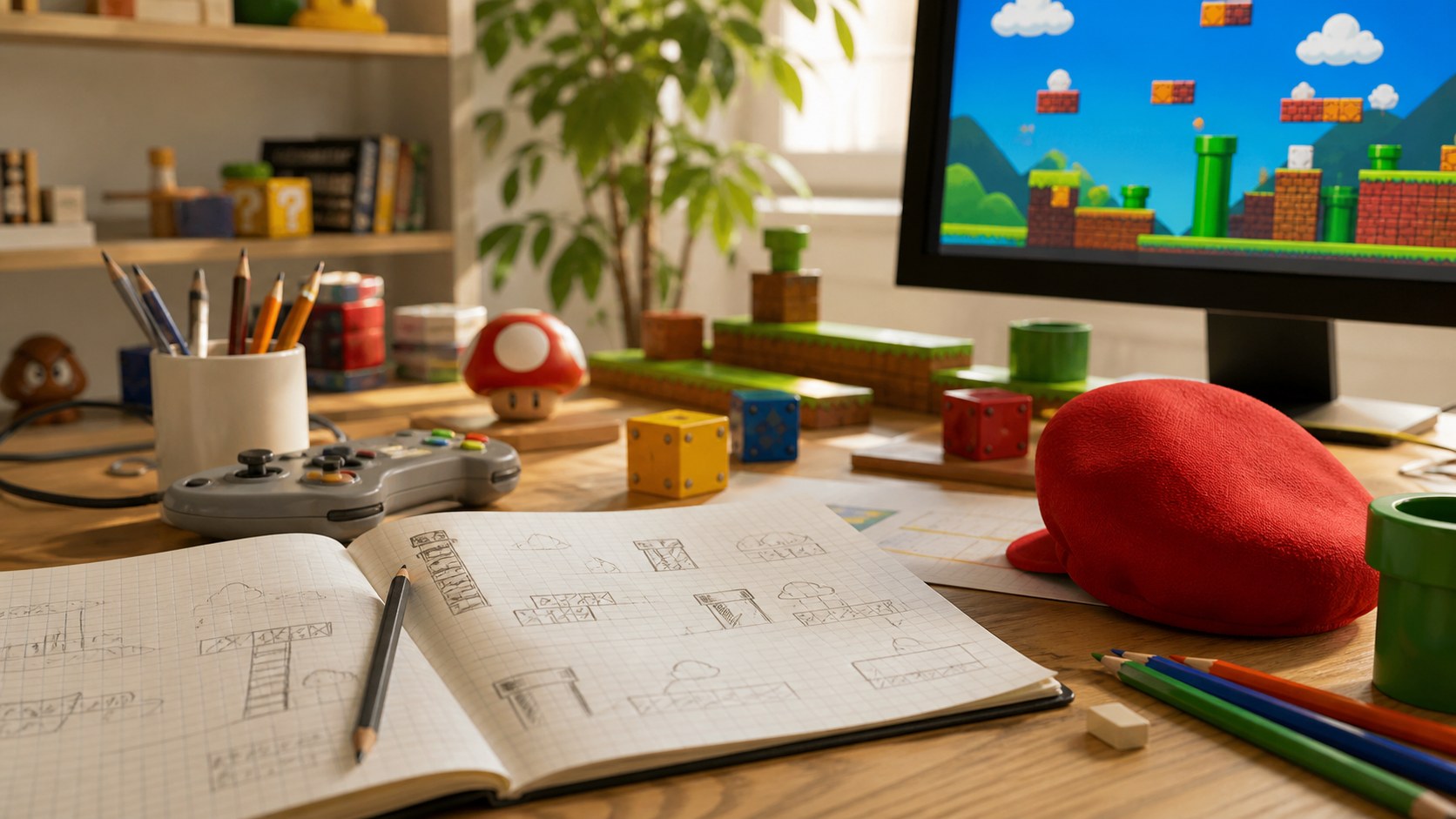
Why Shigeru Miyamoto Changed Video Games
Shigeru Miyamoto changed video games by making play feel clear, physical, and full of discovery. He is widely associated with Mario, Donkey Kong, The Legend of Zelda, and many of Nintendo’s most enduring design ideas, but his influence is larger than a list of characters. Miyamoto helped define how games teach without lectures, how movement can express personality, and how a simple action can support decades of invention. His story is not only about creating Mario. It is about helping games become inviting worlds that players understand through their hands.
- Donkey Kong showed character and clarity in arcade design.
- Mario became a global symbol of playable movement.
- The Legend of Zelda made discovery central to adventure.
- Nintendo platforming taught players through level shape.
- Readable mechanics became a Miyamoto design signature.
- Secrets made playful curiosity feel rewarding.
- Simple actions supported deep variation.
- Character design stayed tied to how games felt.
- Nintendo polish reflected collaborative craft.
- His influence shaped generations of designers.
- Start with what feels good in the player's hands.
- Teach through play whenever possible.
- Make goals clear before adding complexity.
- Reward curiosity with secrets and surprises.
- Use sound and animation to confirm action.
- Let simple mechanics create many situations.
- Make characters readable at a glance.
- Favor approachable depth over confusion.
- Trim friction that weakens joy.
- Build worlds that invite experimentation.
- The jump felt expressive and reliable.
- The silhouette was easy to recognize.
- The colors were bold and readable.
- Levels introduced ideas through safe tests.
- Power-ups changed play instantly.
- Secrets rewarded attention without requiring explanation.
- Movement could support many genres.
- The character was flexible without losing identity.
- Failure taught players quickly.
- Joy came from control, not only appearance.
- Exploration can be a central reward.
- Tools can change how players read the world.
- Secrets make spaces feel alive.
- Old obstacles can become future opportunities.
- Puzzles work best when the environment teaches them.
- Adventure grows from memory and curiosity.
- A world feels bigger when players infer possibilities.
- Music and sound can guide emotion.
- Mystery does not need to be hostile.
- Discovery is strongest when it feels earned.
- Miyamoto's work is collaborative, not solitary.
- Nintendo teams turned ideas into polished games.
- His influence reaches beyond platformers.
- Modern tutorials still study invisible teaching.
- Family-friendly design can still be deep.
- Playful clarity remains hard to achieve.
- Iconic characters need strong mechanics underneath.
- Good design can survive hardware changes.
- Simple ideas can support decades of invention.
- Miyamoto helped define the grammar of video games.
Who is Shigeru Miyamoto?
He is a major Nintendo creator associated with Mario, Donkey Kong, Zelda, and influential game design ideas.
Did Miyamoto create Mario?
He is widely credited as Mario's creator and one of the key figures behind the character's early games.
Why is Miyamoto important?
He helped define readable, playful, mechanics-first game design.
What did Donkey Kong change?
It brought character, story clarity, and expressive jumping into arcade design.
Why is Mario so influential?
Mario made movement, level teaching, and character identity feel tightly connected.
How did Zelda influence games?
It emphasized exploration, tools, secrets, and discovery.
Did Miyamoto work alone?
No. His games were built by Nintendo teams across many disciplines.
What is invisible teaching?
It is teaching players through level design and interaction rather than long instructions.
Why do designers study Mario?
Because its early levels explain mechanics through play with unusual clarity.
Why profile Miyamoto?
His work helped shape how modern players understand games.
Donkey Kong and the Birth of a Design Voice
Miyamoto’s early breakthrough with Donkey Kong showed a design voice built around clarity and character. The game had simple goals, readable hazards, expressive movement, and a tiny story players could understand immediately. It arrived at a time when arcade games were often abstract, and it helped show that games could have personality without becoming confusing. Jumping was not only a mechanic. It was a way to make a character feel alive.
That early lesson continued through Miyamoto’s career. A player should understand what they can do, then discover how many interesting situations grow from that action. Donkey Kong did not need a long explanation. It taught through layout, timing, and repeated attempts.
Mario and the Joy of Movement
Mario became one of gaming’s most important characters because movement felt good. Running, jumping, bouncing, sliding, and exploring carried a sense of physical pleasure that made the world inviting. Super Mario Bros. taught players through level design: the first enemy, the first block, the first pit, the first power-up, and the first secret all introduced ideas through play. That style became one of the most studied design openings in game history.
The character’s flexibility also mattered. Mario could move from platformers to racing, sports, party games, RPGs, and 3D adventures because the design identity was simple and strong. The red cap, mustache, jump, and cheerful momentum became a language that could travel.
Zelda and the Pleasure of Discovery
The Legend of Zelda expressed another side of Miyamoto’s design influence: curiosity. Zelda games invite players to explore, notice patterns, test tools, solve spaces, and feel that secrets might be hidden just beyond the obvious path. The best Zelda design makes discovery feel earned. A cracked wall, odd rock, suspicious clearing, or locked door becomes an invitation to think like an adventurer.
This approach helped shape action-adventure design for decades. Tools were not only inventory items; they changed how players understood the world. A new ability could turn an old obstacle into a future path. That relationship between item, place, and memory became central to how many players imagine adventure games.
Teaching Without Stopping the Player
One of Miyamoto’s greatest influences is the idea that games can teach without stopping the player. A level can introduce a mechanic safely, repeat it with variation, then test it under pressure. The player learns by doing, not by reading a manual. This style respects curiosity. It trusts players to notice, experiment, and connect ideas.
Modern games still chase this kind of invisible tutorial. When a game introduces movement, combat, puzzles, or tools through environment rather than instruction, it is working in a tradition Miyamoto helped popularize. The lesson is not that text is bad. The lesson is that play itself can explain.
Collaboration and Nintendo Craft
Miyamoto’s public profile can make Nintendo history sound like the work of one person, but the reality is deeply collaborative. Programmers, artists, composers, level designers, producers, and many other people made the games possible. Miyamoto’s importance lies partly in how he helped guide priorities: readability, surprise, polish, player feel, and the belief that a mechanic should be enjoyable before it becomes complex.
That collaborative craft is why Nintendo’s best work can feel so carefully shaped. The games often remove friction that other studios might accept. A jump is tuned, a camera is adjusted, a sound confirms an action, a level teaches a pattern. The magic is in the details.
Why Miyamoto Still Matters
Miyamoto still matters because his design values remain useful. Technology has changed dramatically, but players still respond to clear goals, responsive controls, strong silhouettes, playful secrets, and spaces that teach through interaction. His work reminds designers that accessibility and depth are not enemies. A game can be easy to begin and hard to master.
His influence also extends beyond Nintendo fans. Platformers, adventure games, family games, puzzle design, mascot design, and tutorial design all carry echoes of his philosophy. Few creators have shaped the basic grammar of play so broadly.
The Bottom Line on Shigeru Miyamoto
Shigeru Miyamoto is the man most closely associated with creating Mario, but his legacy is bigger than one character. He helped teach the industry that games could be playful, readable, expressive, and full of secrets. He made interaction feel like personality.
The story of Miyamoto is the story of design clarity becoming magic. His best ideas still feel current because they begin with a simple question: what will the player enjoy doing?
Why Miyamoto’s Simplicity Is Hard to Copy
Miyamoto’s simplicity can look easy from a distance, but it is hard to copy. A readable jump, a clear hazard, a satisfying secret, or an inviting first level requires countless small decisions. Remove too much and the game becomes empty. Add too much and it becomes noisy. The balance is delicate. Miyamoto’s best work shows how much thought can hide behind something that feels effortless.
This is why designers still study early Mario and Zelda games. They are not only nostalgic artifacts. They are examples of how to introduce ideas through space, motion, sound, and reward. The games feel friendly because the design has done careful work on the player’s behalf.
Why Mario Became More Than a Character
Mario became more than a character because he became a promise about how a game might feel. Players expect responsiveness, clarity, secrets, color, and a certain generosity of play. That promise allowed Mario to move across genres while remaining recognizable. The character endured because the design identity underneath him endured.
That is the deeper achievement. Many mascots are recognizable. Fewer carry a design philosophy. Mario’s lasting power comes from the way image and interaction reinforce each other.
How Miyamoto Made Play Feel Understandable
Miyamoto’s greatest gift may be making play feel understandable without making it feel small. His best-known games often begin with a simple physical idea: jump, climb, explore, swing, discover, steer, notice. From that starting point, the game builds layers of surprise. The player is not asked to memorize a manual before having fun. They are invited to act, observe the result, and try again. That loop is so basic that it can be easy to forget how carefully it has to be designed.
Mario is the clearest example. The character works because the act of moving him feels expressive. A jump can be cautious, playful, desperate, stylish, or precise. The world responds immediately, and the level design turns that movement into questions. Can you reach that platform? What is in that block? What happens if you run instead of walk? A simple action becomes a conversation between player and space.
Zelda shows another side of the same philosophy. Instead of focusing only on motion, it focuses on curiosity. The player sees a locked door, an odd rock, a suspicious wall, or a distant mountain and begins to form questions. Tools answer those questions by changing what the player can understand. A bomb, hookshot, boomerang, glider, or musical cue is not only an item. It is a new way to read the world.
Miyamoto’s design influence also includes restraint. The most elegant Nintendo ideas often feel polished because something unnecessary was removed. A confusing explanation becomes a visual cue. A clumsy interaction becomes a cleaner animation. A difficult concept becomes a safe first encounter. This kind of simplicity requires confidence. It means trusting the player while carefully shaping what they see first.
The story of Miyamoto should also include the teams that turned these ideas into finished games. Nintendo’s designers, programmers, artists, composers, producers, and testers made the polish real. Miyamoto’s importance is not that he worked alone; it is that his priorities helped define a style of collaborative craft. The games feel generous because many people refined them around the player’s experience.
That is why Miyamoto remains important even to players who prefer very different games. Horror designers, RPG teams, indie creators, puzzle makers, and action developers can still learn from his clarity. A game can be strange, dark, complex, or mature and still benefit from teaching through play. Miyamoto’s legacy is not only Mario. It is the idea that good design can make discovery feel natural.
Why His Influence Is Easy to Miss
Miyamoto’s influence is easy to miss because so many of his lessons became normal. Players now expect early levels to teach naturally. They expect mascots to feel connected to mechanics. They expect secrets to reward curiosity. They expect movement to be tuned with care. When an idea becomes part of the basic grammar of games, the original influence can become invisible. That invisibility is a sign of how deeply it worked.
His games also remind designers that delight is a serious design goal. A bouncing sound, a hidden block, a clever shortcut, a readable enemy, or a satisfying jump can shape a player’s relationship with a game as much as a dramatic story beat. Miyamoto’s work helped legitimize the idea that fun could be studied with precision.
That influence continues because every new generation of players still understands the feeling. A child does not need a lecture to know whether a jump feels good. A designer does not need nostalgia to recognize elegant teaching. Miyamoto’s legacy survives because it lives inside play itself.
What Designers Still Learn From Miyamoto
Designers still learn from Miyamoto because his best lessons are practical. Start with an action that feels good. Put the player in a situation where that action makes sense. Let the first challenge teach safely, then repeat the idea with variation. Reward curiosity. Make the world readable before making it complex. These principles sound simple, but they are difficult to execute with the grace players associate with Nintendo’s strongest work.
His influence is also a reminder that accessibility is not the same as shallowness. A Mario level can be understood by a child and studied by an expert. A Zelda puzzle can be charming on the surface while still teaching spatial reasoning, memory, and experimentation. Miyamoto’s work often treats approachability as the doorway to depth, not as a replacement for it.
That lesson remains useful across genres. A strategy game, horror game, RPG, shooter, or puzzle game can still benefit from readable feedback, clear goals, expressive interaction, and carefully staged discovery. Miyamoto’s legacy lasts because it is less about one mascot than about a durable respect for the player’s first moment of understanding.
Why the Profile Endures
Miyamoto’s profile endures because his work still feels welcoming without feeling disposable. The best Mario and Zelda ideas survive because they begin with direct player feeling: a jump, a secret, a tool, a path, a surprise. That simplicity keeps teaching designers long after the original hardware has faded.